
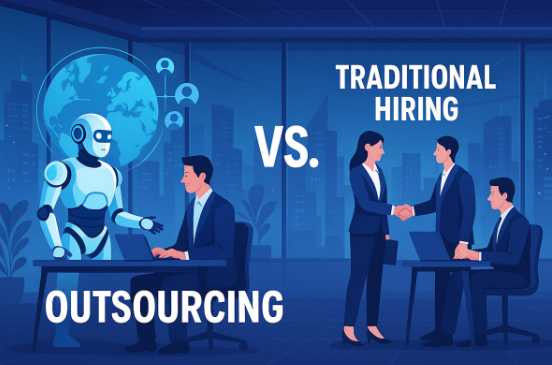
Traditional hiring is starting to feel a little outdated. Long hiring cycles, inconsistent candidate quality, and rising costs have made businesses take a long, hard look at alternatives. One of the biggest shifts? Outsourcing. Not just for call centers or customer support anymore — entire development teams, design functions, and even HR operations are being outsourced now.
So the real question is: are we heading toward a world where outsourcing becomes the go-to method for building a team? Will it completely edge out the usual in-house hiring model?
Let’s break it down.
What’s Driving the Change?
First, companies are under pressure to move fast. Whether it’s launching a new product or scaling tech operations, speed matters. But building an internal team takes time. Posting jobs, screening resumes, interviewing — it can drag out for months. And that’s assuming everything goes smoothly.
Now add rising salaries, talent shortages, and unpredictable retention. It’s no wonder companies are looking at software development outsourcing as a way to get the job done faster and more cost-effectively.
Outsourcing gives you access to skilled professionals across the world. You’re not limited to who happens to be within 20 miles of your office. You get the skills you need, minus the overhead of full-time hiring.
Will This Work for Every Role?
Not exactly. Some positions still benefit from having boots on the ground. There’s real value in face-to-face collaboration, especially for roles tied closely to company culture or sensitive operations.
But a huge chunk of jobs — especially in tech, design, and support — don’t need to be tied to an office or even a local team. And that’s where outsourcing starts to win.
When managed well, remote and outsourced teams can be just as productive — sometimes even more — than in-house staff. Clear communication and project management tools help bridge the gap.
Cost Isn’t the Only Factor
Outsourcing often gets attention for being cheaper. And yeah, reducing payroll costs is a big part of it. But that’s not the whole story.
More companies are turning to outsourcing for flexibility. Let’s say you need a mobile app built, but you don’t need a full-time iOS developer on staff forever. With outsourcing, you bring in experts for a specific project, then move on. No long-term commitments. No bloated payroll.
And when business needs change — which they often do — outsourced teams can scale up or down quickly.
Where Does AI Fit Into This?
Here’s the curveball. As outsourcing grows, so does automation. AI is creeping into hiring processes, too. And we’re not just talking about resume screening or chatbots.
There are full-blown platforms now — like an ai hiring tool — that can handle everything from sourcing to first-round interviews. Some companies are using AI to pre-qualify candidates, filter out bias, and match applicants with job requirements instantly.
These tools don’t exactly replace human recruiters, but they do change how the game is played. You can sift through thousands of applicants in minutes. That’s something a traditional HR team just can’t match on their own.
So, combine outsourcing with AI-powered hiring? Now we’re talking serious disruption.
What About Quality and Control?
This is the part where people hesitate. Letting go of control is scary. You might wonder if an outsourced team will deliver the same quality as an in-house team.
Fair concern.
But that’s why smart outsourcing isn’t just about sending work overseas and hoping for the best. It’s about partnering with the right providers. Ones that communicate clearly, understand your goals, and can show real results.
Good outsourcing isn’t hands-off. You still manage the outcomes — you just don’t manage every tiny detail of how it gets done.
Same goes for AI tools. They’re only as good as the data and logic behind them. The best ones learn and improve. But if you blindly trust an ai hiring tool to pick your team without human oversight, you’re asking for trouble.
What’s Happening on the Ground?
Startups, mid-size companies, and even large enterprises are already outsourcing core parts of their business. It’s no longer just about saving money — it’s about staying competitive.
Remote-first companies? They’re outsourcing from day one. Even companies with physical offices are now blending in-house teams with remote and outsourced support. Think of it like a hybrid workforce. Part local, part global.
Some industries are moving faster than others. Tech leads the way, of course. But marketing, customer service, finance — all are catching on.
Is Traditional Hiring Going Away?
Not completely.
Some roles still demand in-house presence. Think executive leadership, HR, operations. Plus, not every company is ready to manage remote teams or outsourced partnerships. There’s still something to be said for hallway conversations and in-person team bonding.
But here’s what’s likely:
In the next five years, software development outsourcing and contract-based roles will make up a much larger part of how businesses build their teams. Traditional hiring won’t disappear, but it’ll become more selective. Companies will reserve full-time positions for critical roles and outsource the rest.
The shift won’t be dramatic or overnight. It’ll be gradual. But it’s already happening.
What Should You Be Doing Now?
If you’re running a business, managing a department, or even handling hiring yourself, it’s time to rethink how you build your team.
Start by identifying roles that don’t require physical presence. Could those be outsourced? Could project-based work make more sense than full-time staff?
Then, explore your options. Not just for outsourcing, but also for tools that streamline the hiring process. Try out an ai hiring tool to see if it can help you cut through noise and find better-fit candidates faster.
And most importantly, test small. You don’t have to overhaul everything. Pick one project or one role to outsource. Learn what works, what doesn’t, and adjust from there.
So… Will Outsourcing Take Over?
It’s not about total replacement. It’s about choice.
In five years, the most successful companies won’t just hire the old-fashioned way. They’ll mix it up. In-house, outsourced, automated — all depending on the need.
They’ll stop asking “Should we outsource this?” and start asking “What’s the smartest way to get this done?”
That’s where the future’s heading.
